
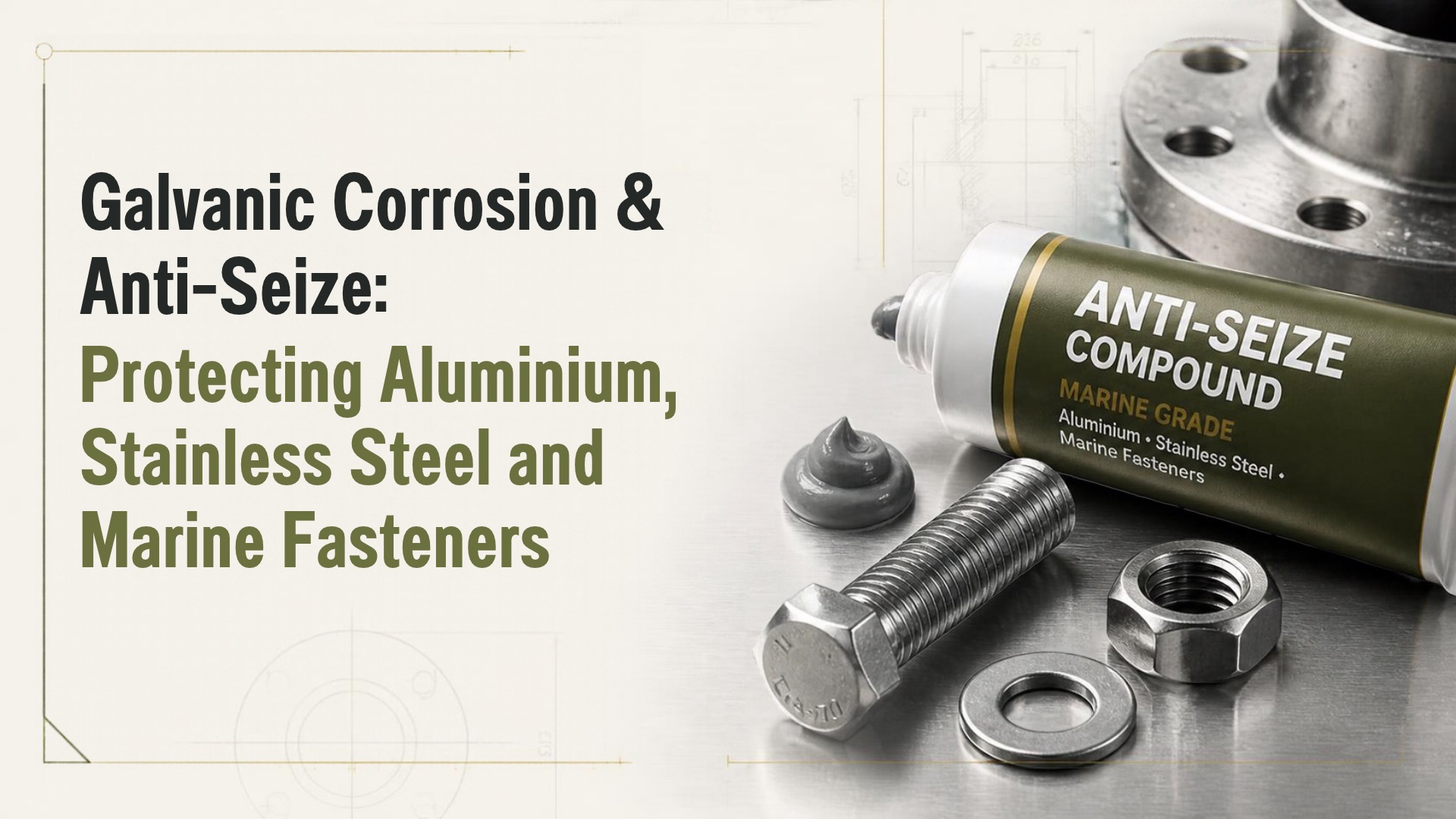
Galvanic corrosion happens when two different metals touch in the presence of moisture or salt: the more reactive metal corrodes faster, and the threads seize. Anti-seize compound helps by separating the threads, filling the gaps where moisture collects, and making the fastener removable years later. For aluminium, stainless steel, and coastal or marine fasteners, an aluminium-based anti-seize compound is generally the safer match, because copper-based products can themselves become the cathode that speeds up corrosion of the aluminium.
What Is Galvanic Corrosion?
Galvanic corrosion needs three things to occur at the same time: two dissimilar metals, direct electrical contact between them, and an electrolyte — for fasteners, usually moisture, and much more aggressively, salt water or salt-laden air. When all three are present, the more reactive metal (the anode) corrodes preferentially while the more noble metal (the cathode) is protected. The greater the difference in electrochemical potential between the two metals, and the more conductive the electrolyte, the faster the damage.
Fasteners are especially vulnerable because the threaded joint traps moisture in tiny gaps and crevices where oxygen is limited, and corrosion products build up. Over time, those corrosion products lock the threads together, and the bolt cannot be removed without cutting or breaking it.
Why Stainless Steel Fasteners Seize Even Without Corrosion
Seizure is not always a corrosion problem. Stainless steel and aluminium fasteners can also seize through galling, in which the thread surfaces cold-weld under tightening pressure and friction. Galling can happen in perfectly dry conditions, which is why stainless fasteners are a standard candidate for anti-seize protection regardless of environment. Coastal and marine conditions then add corrosion on top of the galling risk.
Which Metal Pairs Are Most at Risk?
| Metal pair | Risk level | What typically happens |
| Aluminium with stainless steel | High | Aluminium acts as the anode and corrodes, especially in salt-laden or wet conditions. |
| Aluminium with copper or brass | High | Aluminium corrodes rapidly in contact with copper-based metals. |
| Carbon steel with stainless steel | Moderate | Carbon steel corrodes preferentially and can rust around the joint. |
| Stainless steel with stainless steel | Low corrosion risk, high galling risk | Threads can gall and seize even without corrosion. |
| Aluminium with aluminium | Low corrosion risk, moderate seizure risk | Threads can bind or gall, and oxide builds up in the thread. |
Risk levels are general guidance for planning purposes. Actual behaviour depends on the specific alloys, coatings, surface finish, and operating environment.
Why Copper Anti-Seize Can Be the Wrong Choice on Aluminium
Copper is more noble than aluminium. In a damp or salt-laden environment, copper particles in contact with an aluminium surface can form a galvanic couple, with the aluminium acting as the anode and corroding at an accelerated rate. This is why copper-based compounds are generally recommended for steel fasteners in high-heat areas such as exhausts and manifolds, and why an aluminium-based anti-seize compound is the more suitable match where aluminium or stainless components are involved in humid or corrosive environments. DRP Silicone's guide on copper grease versus aluminium anti-seize covers the differences in detail.
How Aluminium Anti-Seize Helps in Coastal and Marine Conditions
- It separates the thread surfaces, which reduces galling and metal-to-metal contact.
- The paste fills the microscopic gaps in the thread, which limits how much moisture and salt can collect there.
- Because the metallic filler is aluminium, it does not introduce a strongly different metal into an aluminium or stainless joint.
- It keeps threads free so that fasteners can be removed cleanly during planned maintenance.
An anti-seize compound is a layer of protection, not a complete barrier. In severe environments it works best alongside sound design practice: isolating washers or sleeves between dissimilar metals, sealing exposed thread ends, and using protective coatings where possible.
Where This Matters: Coastal and Marine Applications
- Ports, jetties, and shipyards, where equipment sits in salt-laden air
- Offshore and near-shore platforms and marine equipment
- Power plants and industrial plants that use seawater for cooling
- Desalination and water treatment facilities
- Coastal industrial belts such as Mumbai and the Konkan coast, where humidity and salt in the air accelerate corrosion all year round
For fasteners that are continuously immersed in seawater, rather than exposed to splash or salt-laden air, confirm suitability with the technical data sheet and with DRP Silicone's technical team, because immersion conditions can wash out paste-type compounds.
How to Apply Anti-Seize on Coastal and Marine Fasteners
- Clean the threads of dirt, old compound, rust, and oil before you start.
- Apply a thin, even coat of anti-seize to the threads. Excess compound does not add protection and can squeeze out of the joint.
- Reduce the tightening torque where the fastener manufacturer specifies it, since lubricated threads reach the target clamping force at a lower torque. See DRP Silicone's guide to applying aluminium-based anti-seize for torque guidance.
- Wipe away excess compound from the joint after assembly.
- In coastal conditions, inspect exposed fasteners at regular maintenance intervals and re-apply the compound whenever a joint is opened.
Frequently Asked Questions
Can I use copper anti-seize on aluminium?
It is generally best avoided in damp or salt-laden environments. Copper particles can set up a galvanic couple with the aluminium and speed up its corrosion. An aluminium-based compound is usually the safer match for aluminium and stainless steel assemblies.
Does anti-seize prevent galvanic corrosion?
It reduces the problem by separating thread surfaces and limiting the moisture trapped in the thread, but it does not eliminate the underlying cause. For best results, combine it with good design — isolating washers, sealing, and coatings — particularly in marine and coastal conditions.
Why do stainless steel bolts seize?
Stainless steel threads are prone to galling, where the thread surfaces cold-weld together under tightening pressure. Applying anti-seize to the threads before assembly is the standard way to prevent this.
How often should anti-seize be re-applied in coastal conditions?
Re-apply whenever a joint is disassembled, and include exposed fasteners in routine inspection rounds. In harsher marine environments, shorten the inspection interval.
Talk to DRP Silicone
For help selecting an anti-seize compound for aluminium, stainless steel, or coastal and marine assemblies, contact DRP Silicone's technical team.