
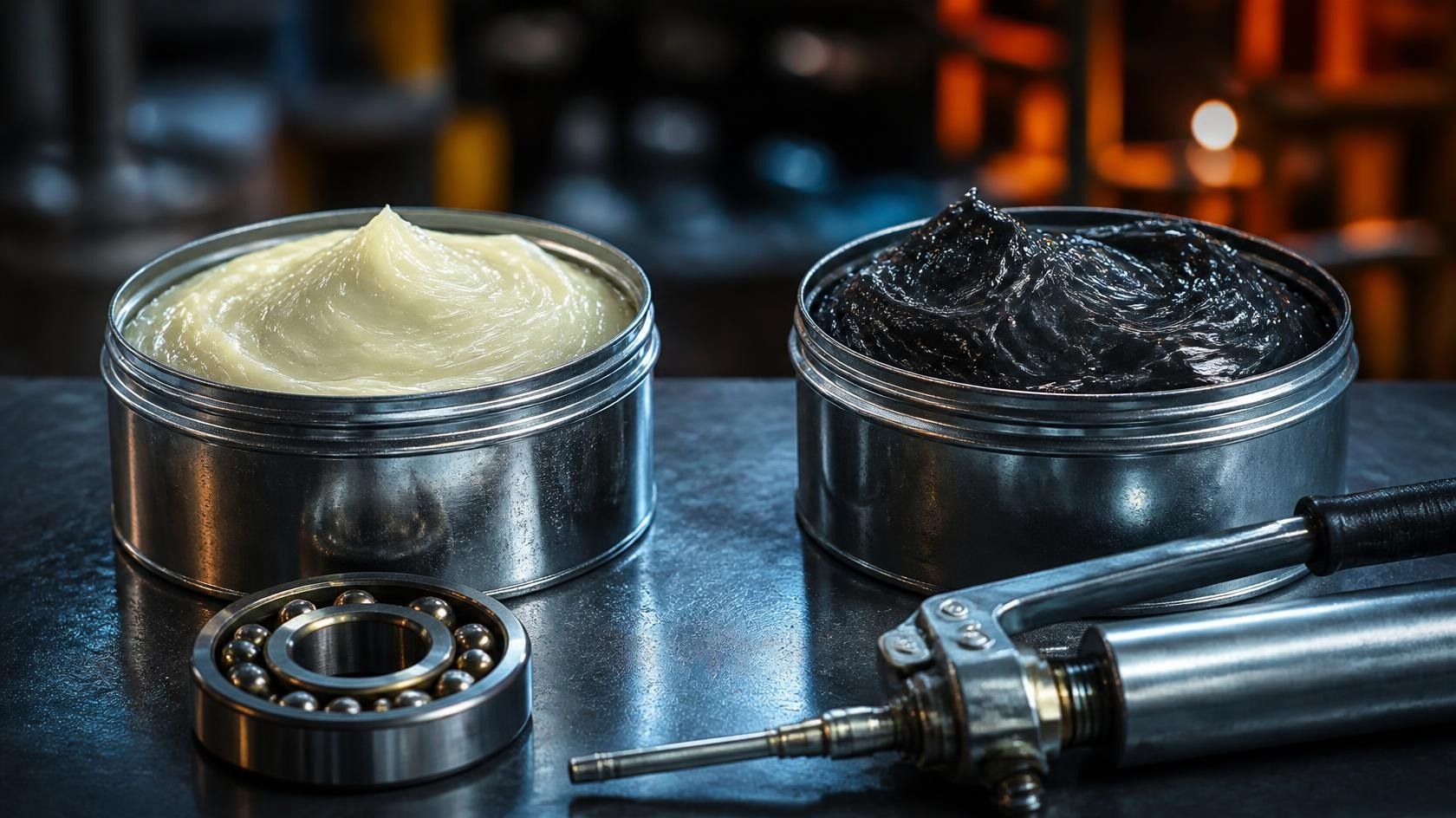
In most cases, no — you should not mix different types of grease. A grease is made of a base oil, a thickener, and additives, and when two greases with different thickeners or base oils are combined, the mixture can soften, harden, or separate into oil and solids, leaving the machine under-protected. Silicone greases are the clearest example: silicone base oil does not blend with the mineral or synthetic hydrocarbon oils used in most lithium and moly greases. The safe approach is to use one grease type per lubrication point, and to clean out the old grease properly before changing to a different one.
Why Mixing Greases Causes Problems
Every grease is a carefully balanced system. The thickener holds the base oil in place like a sponge, and the additives sit inside that structure to deliver wear protection, corrosion resistance, or extreme-pressure performance. When a different grease is introduced, three things can go wrong:
- The thickener structure breaks down. Incompatible thickeners can disrupt each other, so the mixture becomes softer or runnier than either grease on its own and can leak out of the bearing or housing.
- The base oils do not blend. If the two base oils are immiscible, as silicone oil and mineral oil are, the oil separates from the thickener (oil bleed) and the grease can no longer hold a lubricating film.
- The additives are diluted or neutralised. Solid lubricants such as molybdenum disulfide, or anti-wear and rust-inhibiting additives, can be diluted below their effective level or react with the other grease's chemistry.
The result is usually not immediate failure but a gradual loss of lubrication performance — higher operating temperature, noise, accelerated wear, and eventually bearing or component failure. Because the damage is gradual, it is often traced to the wrong cause.
Grease Compatibility Guide: Which Greases Can Be Mixed?
The table below gives general industry guidance for the grease types most relevant to DRP Silicone's range. It is a starting point, not a substitute for the technical data sheet of the specific products involved.
| Combination | General guidance | Why |
| Silicone grease + lithium / mineral-oil grease | Avoid mixing | Silicone base oil is immiscible with hydrocarbon oils, so the mixture separates and loses film strength. |
| Silicone grease + moly grease | Avoid mixing | Most moly greases use a hydrocarbon base; the same immiscibility problem applies. |
| Silicone grease + a different silicone grease | Test first | Both share a silicone base oil, but different thickeners (for example silica vs. soap-based) can still behave differently together. |
| Lithium grease + lithium complex grease | Often compatible, with a possible performance loss | Related thickeners usually mix, but the mixture may have a lower dropping point or different consistency. |
| Moly grease + lithium grease | Depends on the moly grease's base | If the moly grease uses a compatible lithium-type base, mixing is usually tolerated, but the moly content gets diluted. Check the TDS. |
| Copper or aluminium anti-seize + any bearing grease | Do not mix | Anti-seize pastes carry metallic solids for threaded fasteners. In a bearing, those particles can act as abrasives. |
These ratings are general guidance. The only reliable answer for a specific pair of greases is a compatibility test — the standard method is ASTM D6185, which evaluates binary mixtures of lubricating greases — or written confirmation from the manufacturer.
How to Change From One Grease Type to Another Safely
- Identify what is currently in the equipment. Check lubrication records, labels, and the maintenance history before assuming anything.
- Remove as much of the old grease as possible. For bearings and housings that allow it, strip out the old grease; where disassembly is not practical, purge with the new grease until clean new grease emerges from the relief point.
- Clean the grease gun, nipples, and fittings so that residue of the old grease is not carried into the new one.
- Inspect seals and housings for damage or leakage, since a changeover is a good time to catch them.
- Apply the new grease and monitor temperature, noise, and leakage during the first operating period.
- Shorten the first relubrication interval after a changeover, then return to the normal schedule once the equipment runs cleanly.
When Is Mixing Tolerable?
There are a few situations where a small amount of mixing is an acceptable trade-off. If a bearing is about to run dry and only a compatible grease is on hand, a top-up is better than running unlubricated. Two greases that are confirmed compatible, with the same base oil and thickener family, can also be used interchangeably in many general applications. In both cases, treat it as a short-term measure and plan a proper clean-out and relubrication with a single grease type.
Common Mistakes to Avoid
- Assuming that all greases of the same NLGI grade are interchangeable. The NLGI number describes consistency, not chemistry.
- Using one grease gun for several grease types without cleaning it between uses.
- Topping up unlabelled or legacy equipment without finding out what is already inside.
- Using anti-seize compound as a general-purpose bearing grease because it is already on the shelf.
- Mixing greases from different suppliers on the assumption that similar-sounding names mean similar formulations.
Frequently Asked Questions
Can you mix silicone grease with lithium grease?
It is not recommended. Silicone base oil does not blend with the mineral or hydrocarbon oils used in lithium grease, so the combination tends to separate and lose its lubricating film. Clean out the old grease before changing from one to the other.
What happens if you mix incompatible greases?
The mixture may soften and leak, harden, or separate into oil and solids. The result is reduced lubrication, higher operating temperatures, faster wear, and a higher risk of bearing failure.
Can you mix greases of different NLGI grades?
If the greases are otherwise compatible, mixing different NLGI grades produces a consistency somewhere in between. If they are not compatible, a matching NLGI grade does not prevent the problems described above.
How do I know what grease is already in a bearing?
Check maintenance and lubrication records first. If there is no record, treat the grease as unknown, and clean it out fully before applying a new grease rather than topping it up.
Talk to DRP Silicone
Not sure which grease is right for your equipment, or whether your current grease is compatible with a DRP Silicone product? Contact our technical team before you change over.
Phone: +91 99200 99625 | Email: info@drpsilicone.com | Website: drpsilicone.com
Internal linking suggestions (for publishing, not for the live post)
- Link to "Types of Industrial Grease: Lithium vs. Silicone vs. Moly – Complete Comparison Guide" from the compatibility table, since that post covers selection but not mixing.
- Link to "Common Causes of Equipment Failure Due to Poor Lubrication and How Specialty Greases Prevent It" from the section on what goes wrong.
- Link to "When to Use Anti-Seize vs Regular Grease" and the Anti-Seize product pages from the anti-seize row.
- Link to the Silicone Grease and HT Moly Grease product pages from the relevant table rows.